

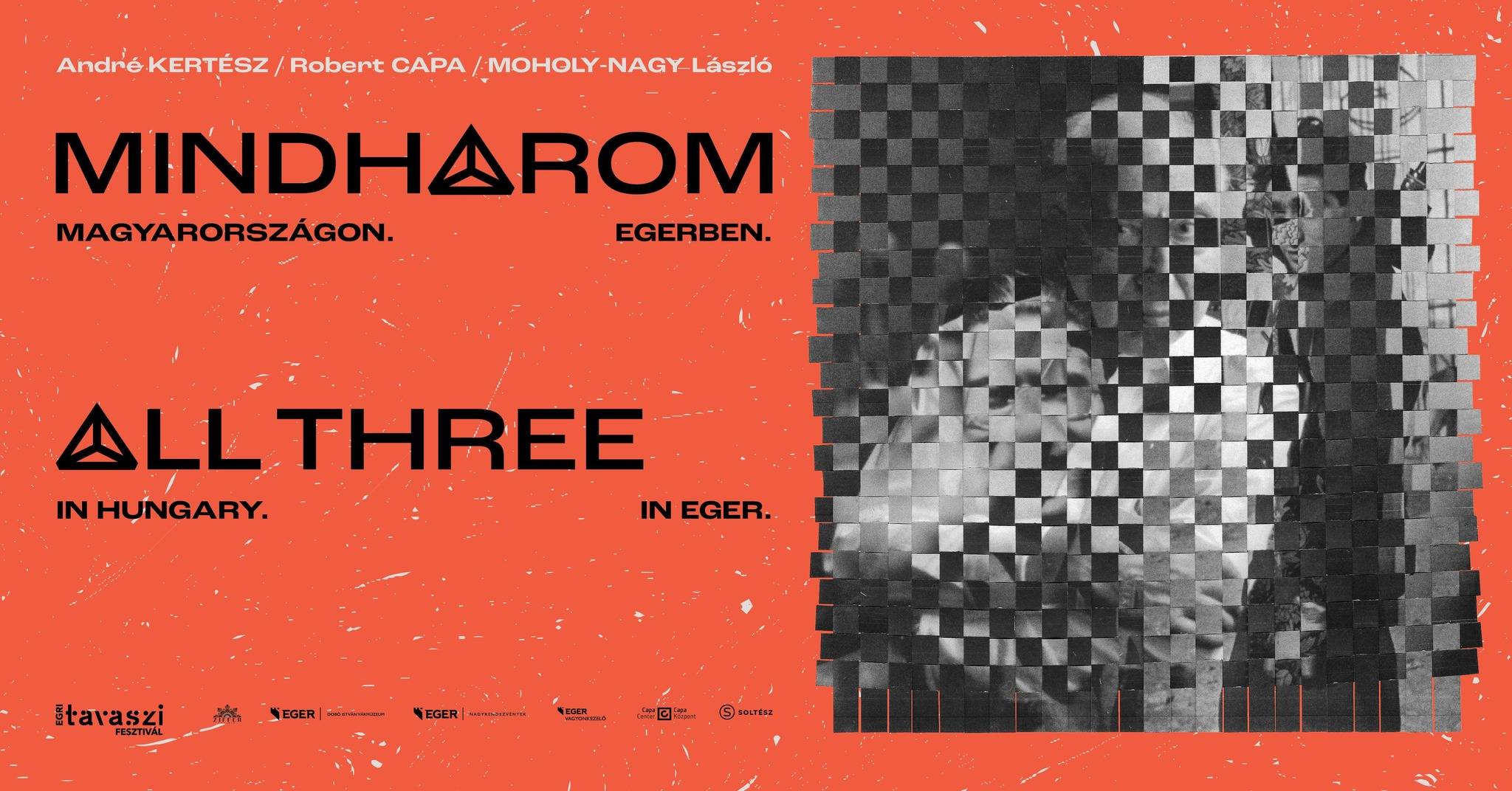
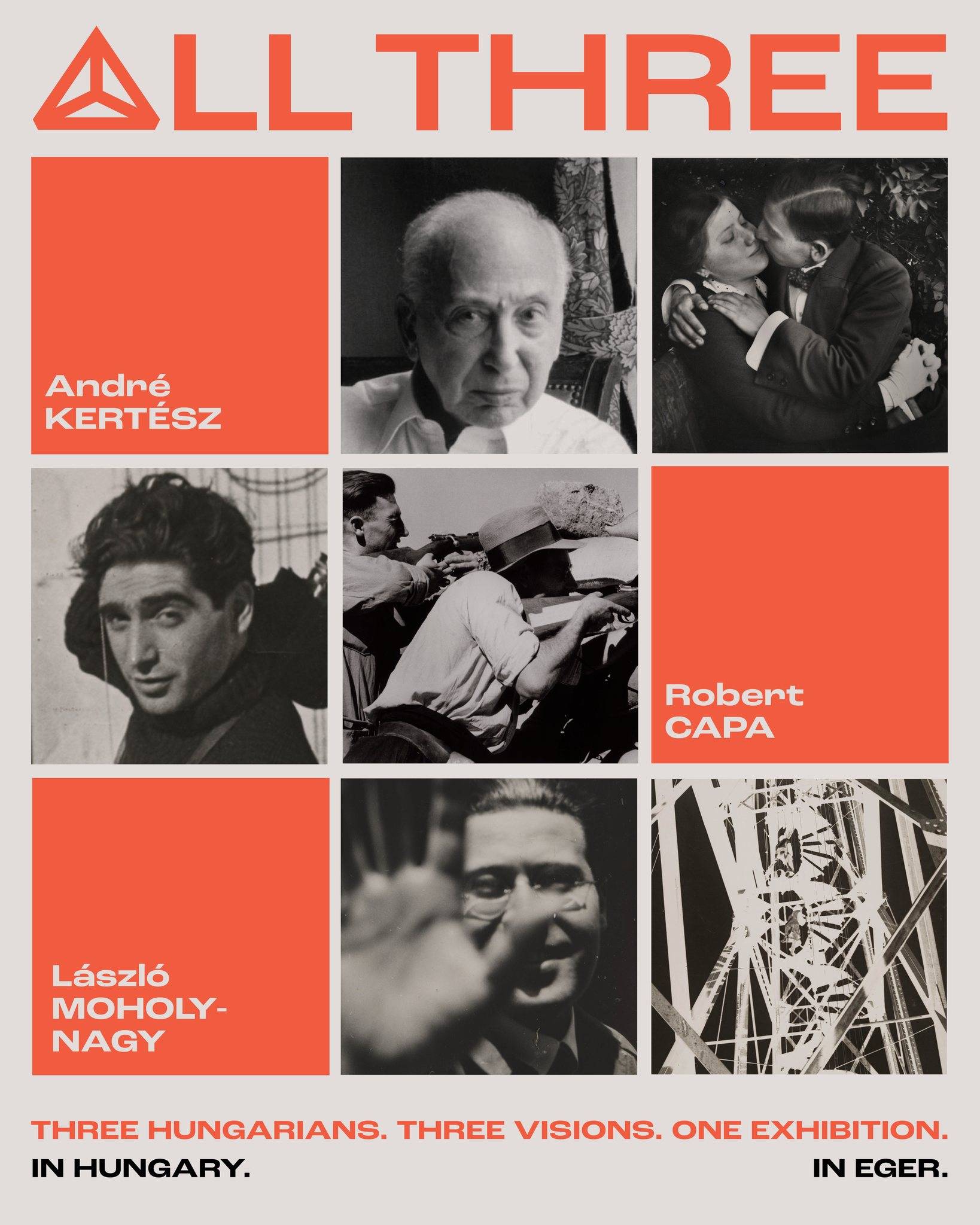
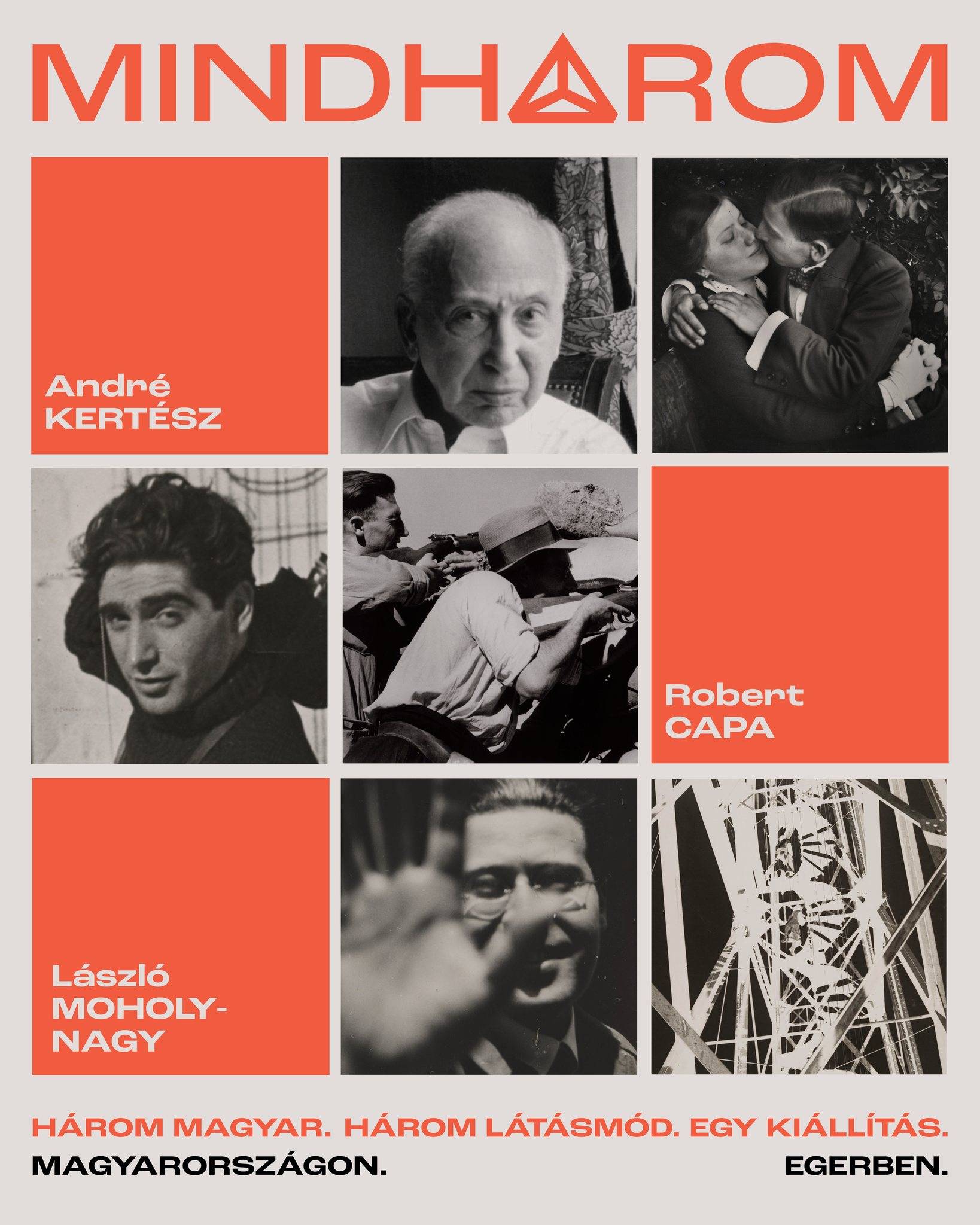
Three world-famous artists who transformed photography.
André Kertész • Robert Capa • Moholy-Nagy László
These three world-famous, Hungarian-born creators, who later moved abroad, are now arriving in Eger with special and significant photographic works.
In the exhibition halls of the István Dobó Castle Museum's Sándor Ziffer Gallery—which once served as an Orthodox synagogue but was renovated by the municipal government and dedicated to public culture—the public can view unique artworks. The exhibition, which rightfully claims international attention, is realized in close cooperation with the Robert Capa Contemporary Photography Center, alongside renowned private and public collections.
The exhibition is on view until May 24, 2026, during the opening hours of the István Dobó Castle Museum's Sándor Ziffer Gallery.
André Kertész (1894–1985) – The Most Successful
He was born into a Jewish family in Budapest. He spent his childhood around Teleki Square in the capital and with relatives in the countryside in Szigetbecse. Serving in the Royal Hungarian Army, he fought in World War I, where he took particularly interesting photographs as a frontline soldier with his camera. After being wounded in 1915, he was mostly treated in Esztergom. He continuously took photographs here and did not stop later either. Around this time, he, his younger brother (Jenő), and his love (Erzsébet) appeared in many of his pictures. He regularly photographed the world of everyday Hungarian country life. He enjoyed experimenting with lights and silhouettes.
At the age of thirty-one, he moved to Paris, the center of the contemporary art world. He soon became friends with painters Picasso, Mondrian, and Chagall, photographer Brassaï, and filmmaker Eisenstein. In 1926, in the Parisian studio of the Heves-born sculptor István Beöthy, he created the series that later made him world-famous. The model for the pictures known as Distortions was cabaret dancer Magda Förstner, but Kertész did not live with her; instead, he lived with his childhood love, Erzsébet Salamon, whom he married in Paris.
At the invitation of Keystone, they moved to New York in 1936. For the next twenty-five years, Kertész photographed for various magazines, but he retired from this work in the early sixties. In 1963, his Distortions series won a grand prize at the Venice Biennale, and the following year he received a solo exhibition at the Museum of Modern Art in New York. By this time, he was considered the most significant photographer in the world. He regularly returned to Hungary, but New York remained his home until the end of his life.
László Moholy-Nagy (1895–1946) – The Most Valuable
He was born in Bácsborsód, a village in Bács-Kiskun County, but spent his youth in Szeged and Budapest. As part of the Royal Hungarian Army, he fought on the Eastern Front as an artillery observer in World War I. Although he took no part in the Hungarian Soviet Republic, after the fall of the commune he moved to Vienna and then to Berlin. He regularly painted, drew, and wrote with literary ambition. In 1920, he met Lucia Schultz in the German capital, who introduced him to the artistic world of photography. They married in 1921. Walter Gropius invited him to join the faculty of the Bauhaus in Weimar in 1923. He found himself among artists like Paul Klee, Wassily Kandinsky, and Oskar Schlemmer. Although Moholy-Nagy's name soon became a trademark of the movement's ideology, he left the Bauhaus in 1928 and also divorced his wife. In late 1931, he met Sybille Pietzsch, whom he married in 1933. Due to the advance of Nazism, they moved to Amsterdam in 1934, where Moholy-Nagy worked as a typographic consultant for a local printing house. At his workplace, he worked with color photography for the first time in his life. In May 1935, they moved on to London, where three of his photo albums were published. In the summer of 1937, on Gropius's recommendation, he was asked to direct the New Bauhaus, which had relocated overseas.
In 1939, Moholy-Nagy and a few colleagues founded the School of Design in Chicago without significant capital, which attained college status in 1944 under the name Institute of Design. He served as the head of the institution until his death two years later. Following several episodes of illness, he was first hospitalized in 1945, where doctors diagnosed him with leukemia. Barely more than a year after the death of Béla Bartók in America, who also suffered from leukemia, he passed away on November 24, 1946. His ashes were buried in Chicago, and Walter Gropius delivered the eulogy at his grave.
In 2006, the 125-year-old Hungarian University of Applied Arts took his name and has since operated as the Moholy-Nagy University of Art and Design. A prize was also named after him there. His geometric picture titled Telephone Picture, created in 1923, was sold for 6 million dollars, or nearly two billion forints, at a Sotheby's auction in New York in 2016—this remains the highest amount ever paid for a Hungarian artwork.
Robert Capa (1913–1954) – The Most Well-Known
The photojournalist, considered by many to be the greatest combat and adventure photographer in history, was born Endre Ernő Friedmann in Budapest in 1913. As a teenager, he ended up in Vienna, Prague, and then Berlin, but following Adolf Hitler's rise to power, he moved to Paris. It was there that he began to actively engage in photography and adopted the name Capa. He regularly went to the most important battlefields of ongoing wars to document the events. His impactful photographs taken during the Spanish Civil War, the Second Sino-Japanese War, World War II, the 1948 Arab–Israeli War, and the First Indochina War were published in the world's most significant magazines. He regularly risked his life as a photographer. Tellingly, he was the only civilian photographer to land on Omaha Beach during the Normandy landings. In 1947, American General Dwight D. Eisenhower awarded Capa the Medal of Freedom for his work documenting World War II in photographs. In the same year, together with French photographer Henri Cartier-Bresson, he founded the market-leading agency Magnum Photos in Paris. Unfortunately, in 1954, he stepped on a landmine in Vietnam and lost his life. Hungary issued a stamp and a gold medal in his honor in 2013, and in 2014, the Robert Capa Contemporary Photography Center was opened in Budapest.
Capa redefined war photojournalism. He became famous for his saying, "If your photographs aren't good enough, you're not close enough." The coinage of the term Generation X is also attributed to him. He undoubtedly used this phrase as the title for a photo essay about the youth coming of age immediately after World War II: "We named this unknown generation, The Generation X, and even in our first enthusiasm we realised that we had something far bigger than our talents and pockets could cope with."
In 1976, Capa was posthumously inducted into the International Photography Hall of Fame and Museum. He is still considered an icon of photographic art today.